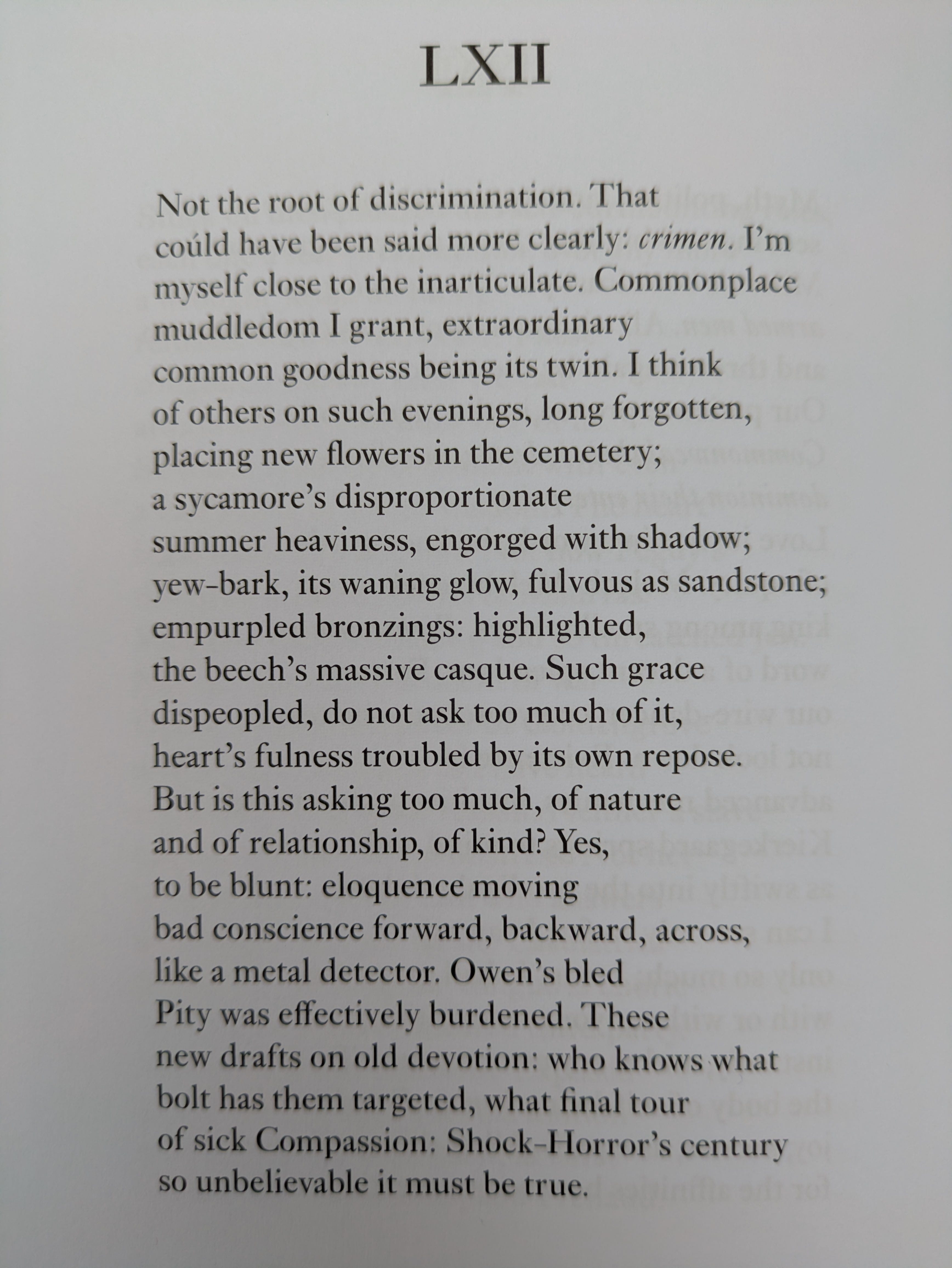
Brief note on late Hill
And endings

Geoffrey Hill build-up, Orchards of Syon: a word like "fulvous" becomes onomatopoeic, all a bit priapic seeking yield, despite exact dictionary meanings. When it came to the metal detector line, I actually shouted "ha!" Then the rest is pillow talk.
This stanza isn't a syllogism; the ending is a little death, on purpose, but with some sense of the death of a little madness.
I've become lately very wary of ways of reading poems that assume an overall meaning, or that the poem has established images in it. I need language and articulation to play a role, almost from a dugout. This stanza really answered that need this morning.
A syllogism relies on simplified language, reduced vocabulary, simplified acts. Then it can assert a truth claim and test it logically. But this stanza isn't doing that. I can spot bathos in Pope's Rape of the Lock, for example, because the images, argumentation and narrative are clear, so it's more like a farce, with twists (the clown unexpectedly doesn't fall, the vicar does). In Pope, the play of etymology is clear and the diction under control so much that it's like maths (vide D Davie). In this late Hill stanza, Hill is recognising that he has collected vocabulary in order to make Hill Poems in perpetuity. But he catches himself doing it, and throughout the sequence advocates for stupidity and vagueness. Hence the metal detector line. Showing what rings true, and also too automated. And then there is a sad sense of age throughout the sequence and in this stanza, hence that kind of career-bathos. The theme throughout the sequence is "life is a dream", and so there are hallucinations and sour wakings and also glad wakings, both still alive and ailing.
(Overall here I'm zooming out from assumptions of how a poem ends: if bathetic, or climactic, of what underlying process are we (not) speaking? Music? – Ending on the tonic? Crescendo? – I posit there an unexplored assumption that a poem is propositional or conclusive: hence, a syllogism.)